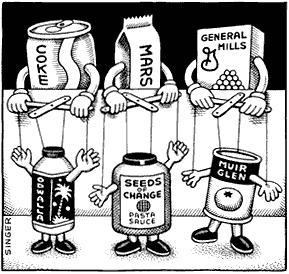
...land ok, but race? Most likely not.
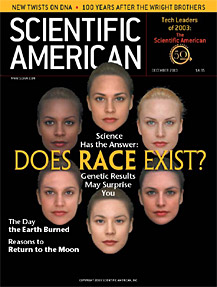 Many years ago, I stumbled over an issue of the Scientific American with the cover you can see to the right. Curiously, I read through the article (fulltext to subscribers only) that easily convinced me, that the common concept of race is - excuse me - bullshit:
The color of your skin and all other features of you physiognomy are only slightly related to the rest of your genetic pool. In other words: Because your skin is black doesn't mean, you have all the other genes to become a great basketball player. Also, the variety within one "race" is way bigger than between different "races":
Just a few days ago, I found another article covering the same theme in Intelligent Life, from I which I took the following excerpt, that explains the issue further:
Cavalli-Sforza's book is from 1994, and still any time you fill in a form in the USA, they ask you, whether you are "Hispanic", "Asian", "African-American" or "Caucasian"... (Caucasian - what's that supposed to be anyway?) Now, which box would Barack Obama tick, who was born to a Kenyan father and a british-irish-geman-American mother? I was glad I'm not the only one finding these questions ridiculous, when reading Richard Dawkin's fantastic book on evolution called "The Ancestors Tale", who laments about "Caucasianism" in one of the chapters.
But even researchers are still serious about making some use of human races: Just recently I stumbled over a medical trial discovering that black men are more likely to suffer from a heart attack when entering the emergency room with chest pain. Am I going to look at every patient and try to figure out whether his skin colour is "black", "white" or somewhere in between? Life as a doctor would just be too easy if outer appearance could guide my decision making process that easy... It's most probably a mix of slight genetic differences and social background that explains these results.
When talking about "differences" among people in the same place, I've always preferred the term "ethnicity", which is described by Wikipedia as:
In CISV, I think we should try and get rid of the term "race" altogether, because - I'll be blunt here - simply accepting the concept of "race" is racism: Thinking that there's something to learn about a person's inside values (intelligence, character, culture) from the way he or she looks is nothing but prejudice. And it's not a question of morale, but real science. This fact is something the participants of our programmes should learn, because it seems like it's not common knowledge yet.
There's just the problem that "ethnicity" doesn't fit the metrics in the CISV song. Otherwise, I'd vote to replace the stupid word "race" once and for all.
Many years ago, I stumbled over an issue of the Scientific American with the cover you can see to the right. Curiously, I read through the article (fulltext to subscribers only) that easily convinced me, that the common concept of race is - excuse me - bullshit: The color of your skin and all other features of you physiognomy are only slightly related to the rest of your genetic pool. In other words: Because your skin is black doesn't mean, you have all the other genes to become a great basketball player. Also, the variety within one "race" is way bigger than between different "races":
Just a few days ago, I found another article covering the same theme in Intelligent Life, from I which I took the following excerpt, that explains the issue further:
Cavalli-Sforza's "The History and Geography of Human Genes", written with Paolo Menozzi and Alberto Piazza (Princeton University Press, 1994), is still considered the best overview of genetic diversity in humans. Cavalli-Sforza demolished the idea of there being different species of human being. No more Homo afer, asiaticus, europaeus, americanus and monstrous. Race, says Cavalli-Sforza, has hardly any useful biological meaning at all. It is about adaptation. Grain-eaters between the Baltic and Black Sea got pale skin, pale eyes and pale hair because they were under selective pressure to process more Vitamin D from limited sunlight. Lewontin, Wells's other mentor, posited that if a nuclear war struck and only the Kenyan Kikuyu survived, they would still have 85% of the genetic variation of mankind; with a similar history and conditions, they too would turn blond and blue-eyed under the northern sun.Compared to other kinds of animals - that have vast genetic differences within one species - the human species is mostly the same, because our ancestors spread the world just relatively recently ago. What seems as huge differences in skin color, shape of the skull, nose or eyes, are really - evolutionary speaking - recent variations.
Cavalli-Sforza's book is from 1994, and still any time you fill in a form in the USA, they ask you, whether you are "Hispanic", "Asian", "African-American" or "Caucasian"... (Caucasian - what's that supposed to be anyway?) Now, which box would Barack Obama tick, who was born to a Kenyan father and a british-irish-geman-American mother? I was glad I'm not the only one finding these questions ridiculous, when reading Richard Dawkin's fantastic book on evolution called "The Ancestors Tale", who laments about "Caucasianism" in one of the chapters.
But even researchers are still serious about making some use of human races: Just recently I stumbled over a medical trial discovering that black men are more likely to suffer from a heart attack when entering the emergency room with chest pain. Am I going to look at every patient and try to figure out whether his skin colour is "black", "white" or somewhere in between? Life as a doctor would just be too easy if outer appearance could guide my decision making process that easy... It's most probably a mix of slight genetic differences and social background that explains these results.
When talking about "differences" among people in the same place, I've always preferred the term "ethnicity", which is described by Wikipedia as:
An ethnic group (or ethnicity) is a group of people whose members identify with each other, through a common heritage, consisting of a common language, a common culture (often including a shared religion) and a tradition of common ancestry (corresponding to a history of endogamy).With common ancestry comes a common gene pool, so in a way "ethnicity" includes what people understand as "races", but includes culture as well, which makes just so much more sense.
In CISV, I think we should try and get rid of the term "race" altogether, because - I'll be blunt here - simply accepting the concept of "race" is racism: Thinking that there's something to learn about a person's inside values (intelligence, character, culture) from the way he or she looks is nothing but prejudice. And it's not a question of morale, but real science. This fact is something the participants of our programmes should learn, because it seems like it's not common knowledge yet.
There's just the problem that "ethnicity" doesn't fit the metrics in the CISV song. Otherwise, I'd vote to replace the stupid word "race" once and for all.


![Reblog this post [with Zemanta]](http://img.zemanta.com/reblog_c.png?x-id=073f8dc1-3254-4143-8007-f2f6d628f126)